Mushroom Coffee Recipes:
From Simple to Barista-Level
Why freshly roasted local coffee changes everything — and how to make the most of it with quality mushroom extracts.
Mushroom coffee has gone from wellness novelty to a daily ritual for thousands of people. But most recipes online start with instant coffee or pre-mixed powders — and that’s where they go wrong. The coffee you choose matters as much as the mushroom extract you add to it.
This guide covers why freshly roasted, locally sourced coffee dramatically outperforms instant products on antioxidant content, flavour, and overall health value — then walks you through everything from a no-fuss morning americano to full barista-level drinks worth making on the weekend.
Before diving into recipes: if you’re still figuring out which mushroom extract to buy, our Mushroom Supplement Buying Guide covers everything — beta-glucan content, extraction methods, COA red flags, and the difference between products that actually work and ones that don’t. It’s worth reading before you spend money on an extract.
The Foundation
Why Fresh-Roasted Local Coffee Is Non-Negotiable
The whole point of mushroom coffee is to combine the antioxidant and adaptogenic benefits of medicinal mushrooms with the stimulating compounds in coffee. But if your coffee base is nutritionally depleted before you even start, you’re undermining half the equation.
Freshly roasted coffee — ideally from a local roaster — is measurably higher in chlorogenic acids, the primary antioxidant class in coffee. These compounds begin degrading immediately after roasting, and continue degrading with every week on the shelf. By the time instant coffee is processed (spray-dried or freeze-dried), the chlorogenic acid content has dropped substantially compared to freshly ground beans.
Beyond antioxidants, fresh coffee simply tastes better — which matters when you’re building a daily ritual. A mediocre base makes even the best Lion’s Mane extract taste like an afterthought.
“Buy beans roasted within the last two weeks from a local roaster. Grind fresh before each brew. Everything else is secondary.”
The same quality gap exists on the mushroom side. The pre-mixed mushroom coffee products you’ll find in supermarkets and online are often made with low-grade mycelium powder, minimal actual mushroom content, and instant coffee as the base — combining the worst of both worlds. Before buying any ready-made mushroom coffee product, read our guide to mushroom coffee quality — it covers the red flags to look out for and what actually separates a worthwhile product from an overpriced marketing exercise.
What to look for at a local roaster: ask for the roast date (not a “best by” date), choose a medium roast for the best balance of antioxidant retention and flavour complexity, and store beans in an airtight container away from light. Avoid pre-ground coffee if possible — grinding exposes surface area to oxygen and accelerates degradation.
| Factor | Fresh Local Roast | Supermarket / Instant |
|---|---|---|
| Chlorogenic acid content | High — peaks 7–14 days post-roast | Low — significantly degraded |
| Flavour complexity | Full, nuanced, terroir-driven | Flat, oxidised, one-dimensional |
| Roast date transparency | Always labelled | Rarely disclosed |
| Processing damage | None — whole bean | Spray-drying destroys volatile compounds |
| Cost per cup | Lower than you think (~$0.40–0.80) | Higher per gram of actual quality |
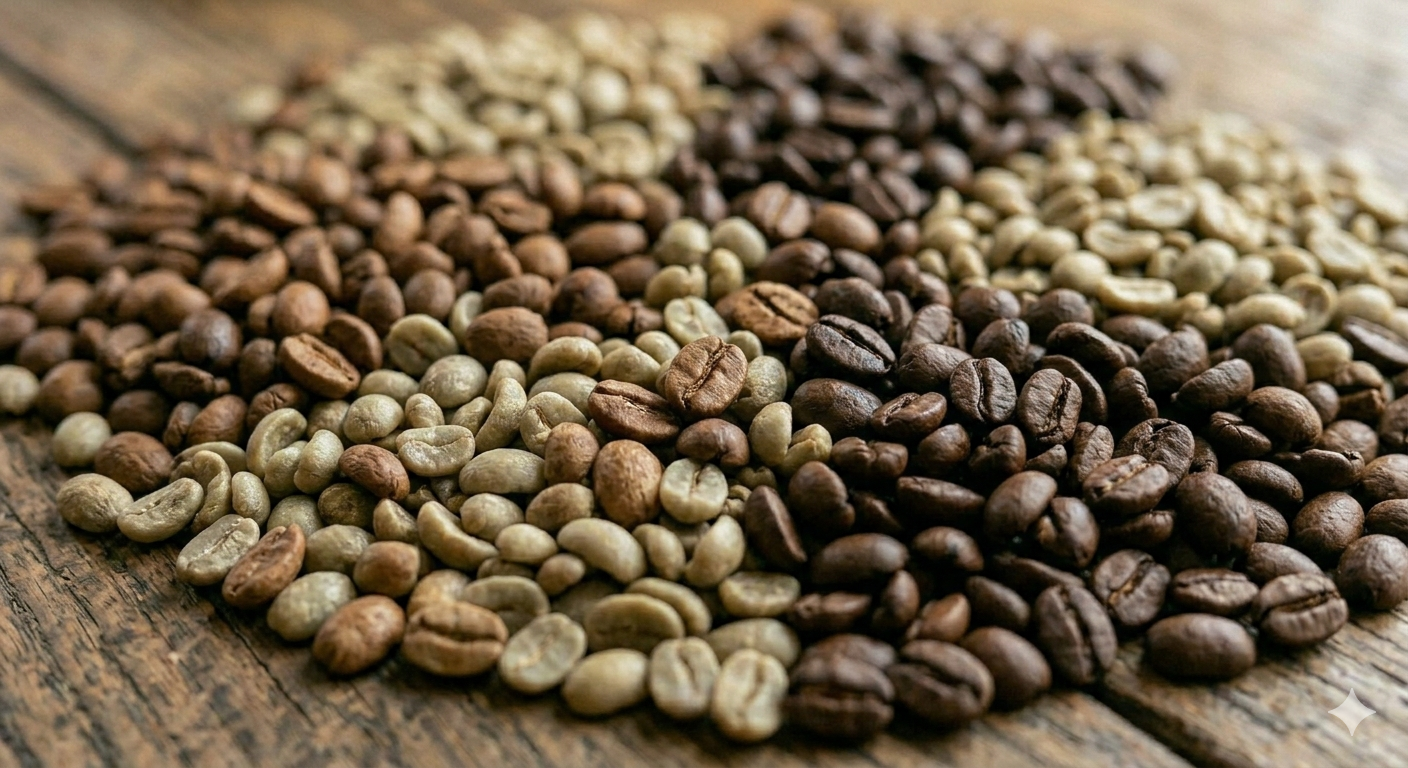
Freshly roasted beans from a local roaster are the single biggest upgrade you can make to any mushroom coffee recipe.
Choosing Your Extract
Which Mushroom Extract Works Best in Coffee?
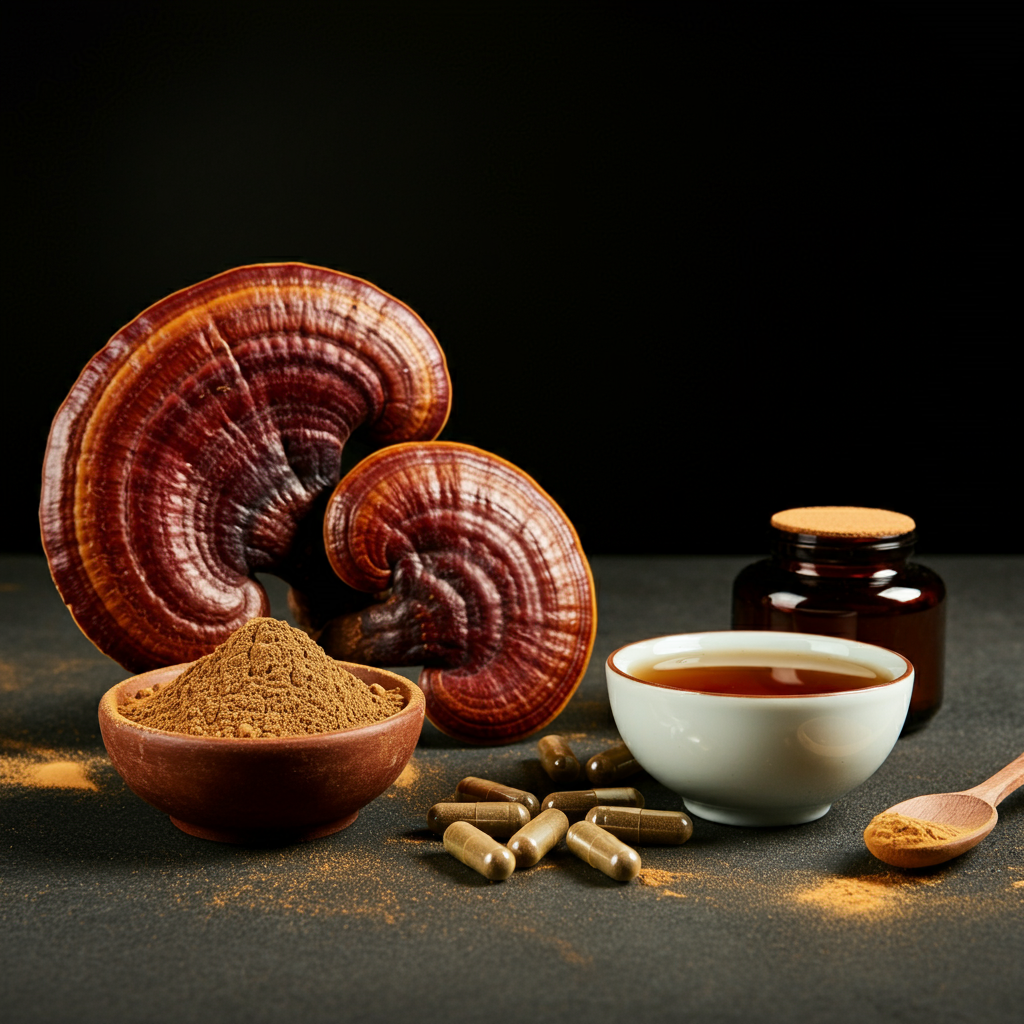
Not all mushroom extracts dissolve or taste the same. For hot and cold coffee drinks, you want a quality fruiting body extract powder — ideally hot water extracted — that disperses cleanly without grittiness or bitterness that fights with the coffee.
Lion’s Mane
Hericium erinaceusMildest flavour — nearly tasteless. Best for everyday drinks where you don’t want any mushroom taste. Associated with cognitive support and NGF production.
Chaga
Inonotus obliquusEarthy, slightly vanilla-like. Pairs exceptionally well with dark roasts. High in antioxidants (superoxide dismutase). A classic pairing with coffee.
Reishi
Ganoderma lucidumBitter and woody — but that bitterness is a signal of potency, not a flaw. Best used in small doses (¼ tsp) blended with milk-based drinks. Evening wind-down favourite. Always choose a double-extracted Reishi for maximum triterpenoid content.
Turkey Tail
Trametes versicolorMild, slightly earthy. Dissolves cleanly. One of the most clinically studied mushrooms for immune support. Good all-rounder for any recipe.
Cordyceps
Cordyceps militarisSubtle, slightly sweet. Pairs well with pre-workout cold brew recipes. Associated with ATP production and endurance. Strong combination with coffee for energy.
Blends
Multi-extractMany quality brands offer dual or triple extracts. Look for double-extracted products — hot water extraction captures beta-glucans, while alcohol extraction captures fat-soluble compounds like Reishi triterpenes. Single-extraction products leave half the picture behind. Always check the COA for both beta-glucan and triterpenoid figures before buying.
Extract Quality
Why Double-Extracted Powders Are Worth It
Not all mushroom extract powders are created equal. A double-extracted powder uses two sequential extraction methods: first hot water (which pulls the water-soluble beta-glucans and polysaccharides), then alcohol (which captures the fat-soluble compounds — triterpenes in Reishi, sterols, and other bioactives that hot water alone misses). The two extracts are then combined into a single concentrated powder.
Single-extraction products — including many popular brands — only capture one half of the mushroom’s bioactive profile. For Reishi in particular, skipping the alcohol extraction means losing most of the triterpenoid content that gives the mushroom its distinctive bitterness and much of its adaptogenic character. When in doubt, check the COA and look for both beta-glucan and triterpenoid content on the product’s testing documentation.
One Tool Worth Having: A Handheld Milk Frother
A simple battery-powered milk frother — the small handheld wand kind you can find for a few dollars — is the single most useful tool for making mushroom coffee. Extract powders, especially double-extracted ones, can clump or settle rather than dissolve cleanly when simply stirred. A frother emulsifies them in seconds, creating a smooth, evenly dispersed drink with no gritty residue at the bottom of the cup.
It’s also invaluable for creating foam on any milk-based recipe without a steam wand. If you only buy one piece of equipment for your mushroom coffee ritual, make it this.
Dosing guide: most fruiting body extract powders recommend ½–1 teaspoon (approximately 1–2g) per serving. Start at the lower end and adjust to taste. Reishi is the exception — its bitterness means ¼ tsp is usually enough, though as covered below, that bitterness can become something you come to appreciate.
The Recipes
8 Mushroom Coffee Recipes
Organised from simplest to most involved. All recipes use freshly brewed coffee as the base — never instant. Mushroom extract quantities assume a standard ½ tsp serving unless otherwise noted.
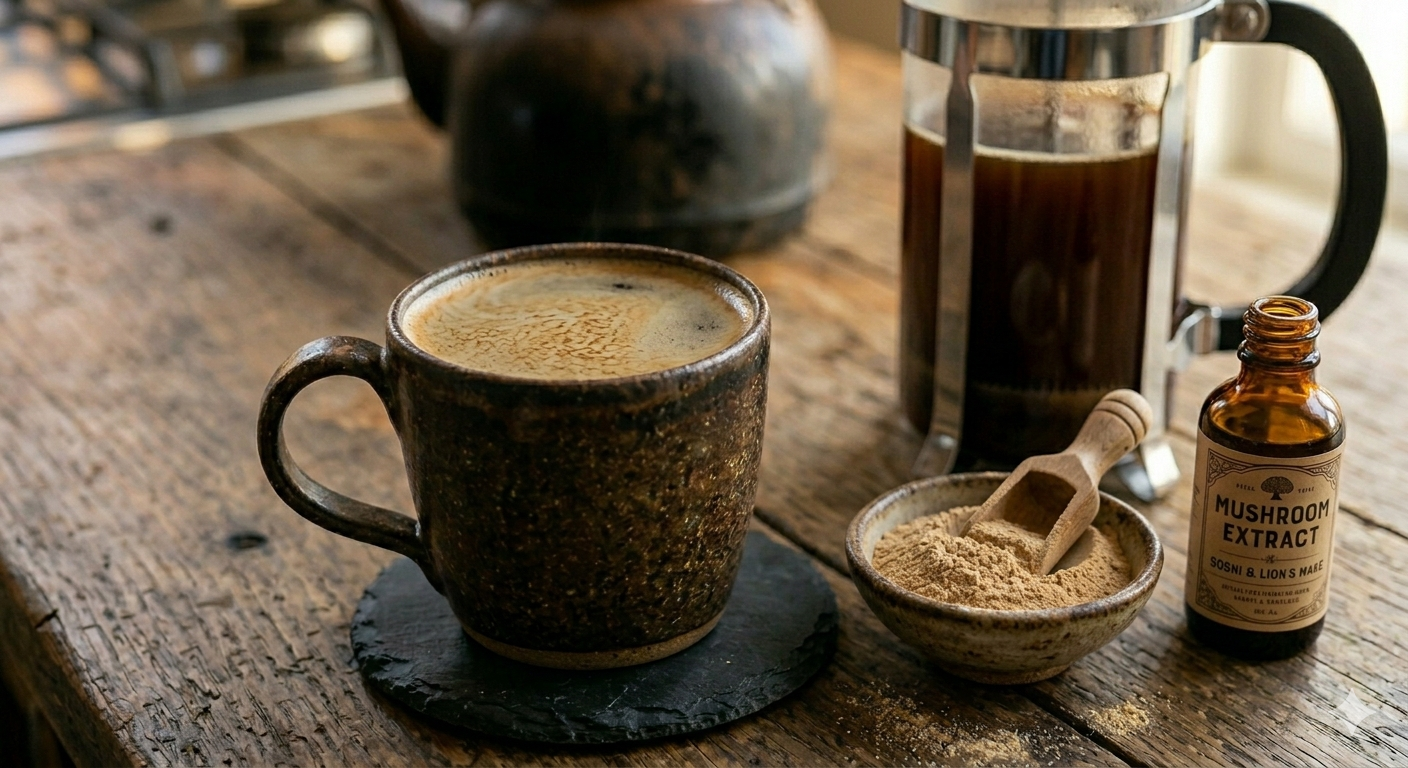
The Mushroom Americano
The foundation — simple, no-fuss, and exactly what most people make every morning.
This isn’t really a recipe so much as a method — but it’s the one most people start with, and worth doing right. Whether you’re using an espresso machine, a drip machine, a French press, or a Moka pot, the principle is identical: brew your coffee as usual, then stir in your mushroom extract powder. That’s it.
Ingredients
- 1 double espresso or 200ml strong brewed coffee
- ½ tsp Lion’s Mane or Chaga extract powder
- Hot water to taste (for americano style)
Method
- 1Brew your coffee using your preferred method. Fresher beans = more antioxidants.
- 2Add mushroom extract powder directly to the hot coffee.
- 3Stir for 20–30 seconds until fully dissolved. A handheld milk frother works best — it emulsifies the powder completely in seconds and prevents any gritty residue.
- 4Add hot water to taste if making an americano-style drink.
Classic Mushroom Latte
The everyday workhorse. Creamy, balanced, and adaptable to any milk.
Ingredients
- 1 double espresso (freshly ground, medium roast)
- ½ tsp Lion’s Mane or Chaga extract
- 200ml oat milk or whole milk
- Optional: ½ tsp raw honey or maple syrup
Method
- 1Pull a double espresso into a wide latte glass.
- 2Stir in the mushroom extract powder until dissolved.
- 3Steam or froth milk to 60–65°C. Oat milk froths exceptionally well and complements earthy mushroom flavours.
- 4Pour milk over espresso, holding back foam. Spoon foam on top.
- 5Sweeten if desired.
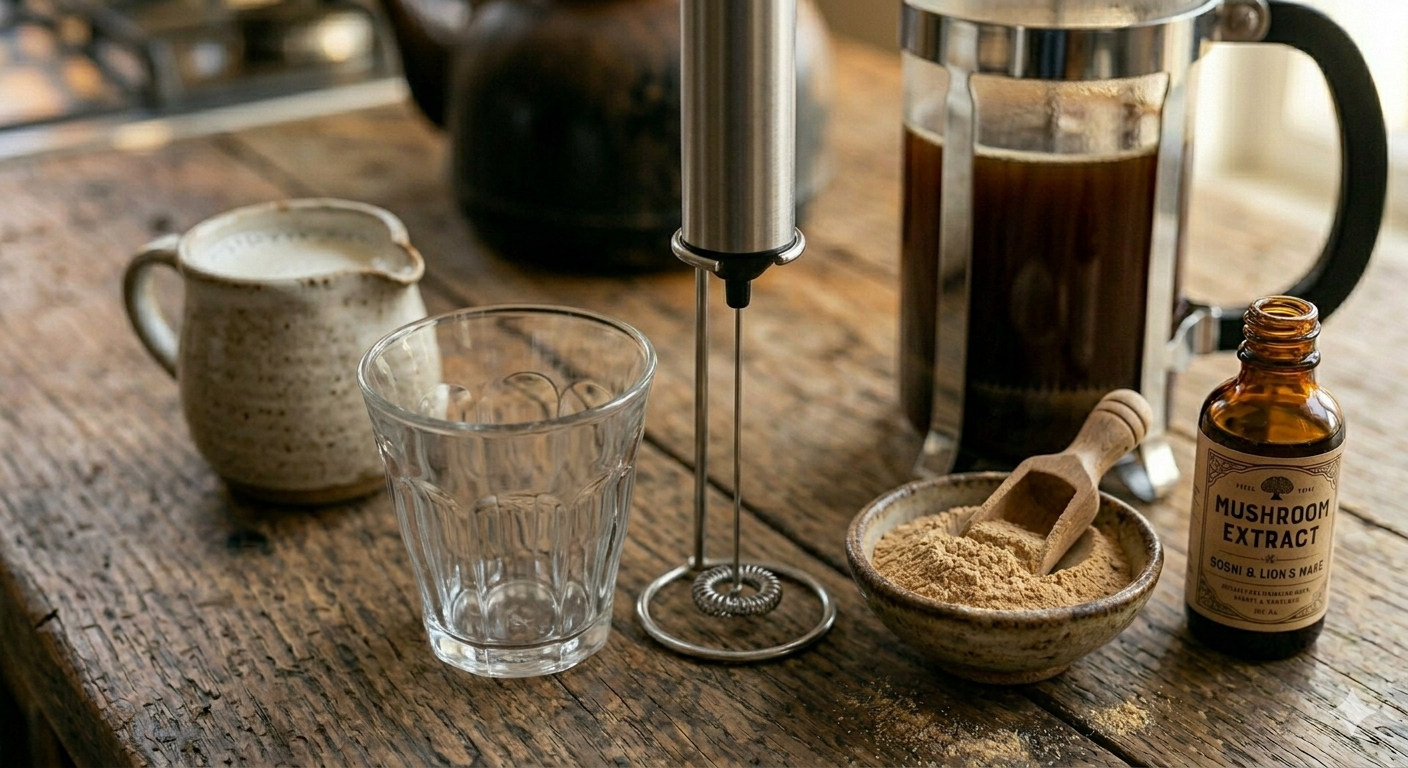
Mushroom Cortado
Equal parts espresso and steamed milk. Intense, elegant, and the barista’s favourite ratio.
Ingredients
- 60ml double espresso (freshly ground)
- ¼ tsp Chaga or Lion’s Mane extract
- 60ml whole milk or barista oat milk
Method
- 1Pull a precise 60ml double espresso into a small cortado glass.
- 2Stir in mushroom extract until fully dissolved.
- 3Steam milk to 60°C with minimal foam — you want microfoam, not froth. The milk should be glossy and pourable.
- 4Pour slowly over the espresso in a 1:1 ratio.
Reishi Evening Latte
A low-caffeine wind-down drink. Reishi’s calming adaptogenic properties meet decaf or half-caf espresso.
Ingredients
- 1 shot decaf espresso (fresh-roasted decaf beans)
- ¼ tsp Reishi extract
- 200ml oat or almond milk
- 1 tsp raw honey or maple syrup
- Pinch of cinnamon
Method
- 1Brew a single decaf espresso shot.
- 2Dissolve Reishi extract and sweetener into the hot espresso — Reishi is bitter, so the honey balances it.
- 3Steam milk and pour over. Finish with a pinch of cinnamon.
Mushroom Cold Brew
Make a batch on Sunday. Drink it all week. High antioxidants, smooth extraction, zero bitterness.
Ingredients
- 80g coarsely ground fresh coffee
- 1 litre cold filtered water
- 1 tsp Cordyceps or Lion’s Mane extract per serving (add at serving time)
- Ice to serve
Method
- 1Combine coarsely ground coffee and cold water in a large mason jar. Stir gently.
- 2Cover and refrigerate for 12–18 hours. Longer = stronger.
- 3Strain through a fine mesh strainer lined with a paper filter.
- 4To serve: pour concentrate over ice (dilute 1:1 with water or milk), then stir in your mushroom extract powder.
Mushroom Flat White
The Australian barista classic — ristretto-based, velvety microfoam, strong coffee presence.
Ingredients
- 2 ristretto shots (30ml each — short, concentrated pulls)
- ¼ tsp Lion’s Mane extract
- 120ml whole milk or barista oat milk
Method
- 1Pull two ristretto shots — shorter extraction than espresso, sweeter and more concentrated. Stop at 30ml per shot.
- 2Stir Lion’s Mane extract into the hot ristretto.
- 3Steam milk to 60°C with very fine microfoam — the texture should resemble wet paint. Almost no visible bubbles.
- 4Pour at a consistent rate from low, finishing with a small latte art pour if desired.
Chaga Cappuccino
Equal thirds espresso, steamed milk, and thick foam. Chaga’s earthiness makes it the perfect cappuccino mushroom.
Ingredients
- 1 double espresso (60ml)
- ½ tsp Chaga extract
- 120ml whole milk
- Optional: dusting of raw cacao powder
Method
- 1Pull a double espresso into a 180ml cappuccino cup.
- 2Stir Chaga extract into espresso until dissolved.
- 3Steam milk to 60°C, incorporating more air than a latte to build a thicker, drier foam.
- 4Pour steamed milk (about ⅓ of volume), then spoon thick foam to fill.
- 5Dust with raw cacao for an antioxidant double-down.
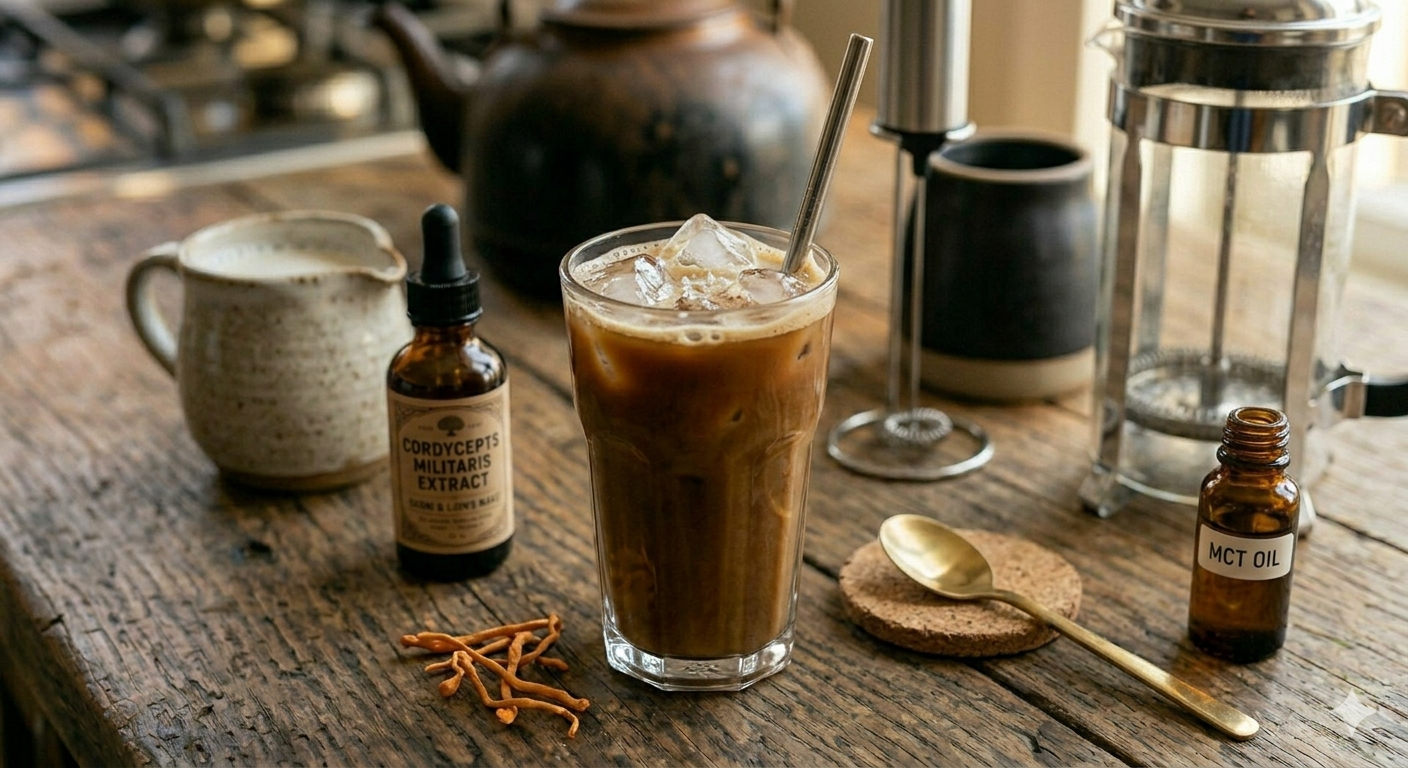
Cordyceps Pre-Workout Cold Coffee
Cold, fast, functional. Cordyceps + caffeine for clean energy without a hard crash.
Ingredients
- 2 double espresso shots or 150ml strong brewed coffee, chilled
- 1 tsp Cordyceps militaris extract
- 150ml unsweetened almond or oat milk
- 1 tsp coconut oil or MCT oil (optional)
- Ice
- Pinch of sea salt
Method
- 1Brew espresso or strong coffee and allow to cool (or refrigerate overnight).
- 2Combine chilled coffee, mushroom extract, milk, MCT oil, and salt in a blender or shaker.
- 3Blend 20 seconds or shake vigorously for 30 seconds.
- 4Pour over ice. Drink 30–45 minutes before training.
Quick Reference: Making the Best Mushroom Coffee
- Always start with freshly roasted beans — buy from a local roaster and check the roast date, not just the best-by date
- Grind beans immediately before brewing for maximum antioxidant and flavour preservation
- Use ½ tsp (1–2g) of fruiting body extract powder per serving as a starting point
- Always choose double-extracted powders — single-extraction misses fat-soluble triterpenes and other key bioactives
- Reishi is bitter — but that bitterness is a sign of quality; start with ¼ tsp and let your palate build a relationship with the flavour over time
- Use a handheld milk frother to dissolve extract powder — far more effective than a spoon, especially for double-extracted powders
- For cold drinks, add extract at serving time rather than during brewing
- Chaga pairs best with dark roasts; Lion’s Mane is the most versatile and flavour-neutral option
- Always choose a double-extracted, fruiting body product — check the COA for both beta-glucan and triterpenoid content before buying
No responses yet